Tracing the Evolution of Networking
In the early days of telephony, making a phone call wasn’t automatic: it required a physical connection. When someone picked up the phone to make a call, an operator would establish the connection by plugging cables into the appropriate jacks on a switchboard.
This action created a continuous and exclusive electrical path between two endpoints, forming a closed loop that allowed signals to flow in both directions. The connection remained dedicated to that call for its entire duration. This method became known as circuit switching, named after the physical act of switching cables to establish the communication path.

Picture: Operator manually reconnecting wires to establish a telephone call at the beginning of telecommunications (circa 1880s–1920s), when voice communication relied on circuit switching.
The concept of packet switching emerged in the 1960s as an alternative to circuit switching. Rather than reserving a dedicated path, packet switching breaks data into small, independent units called packets, which can travel separately across the network using any route. Packet switching allows multiple transmissions to coexist over shared infrastructure, making far better use of available connections but presenting other challenges.
Each packet includes a header with metadata (such as origin, destination, and sequence order) and a payload carrying the actual data. Once all packets reach their destination, they are reassembled in the correct order which involves extra processing performed in the electrical domain.
The concept became practical in the 1970s with the development of the Transmission Control Protocol/Internet Protocol (TCP/IP), which defined how packets are addressed, routed, and delivered across heterogeneous systems. Its adoption as the Internet standard in the 1980s allowed previously incompatible networks to communicate under a common framework.
To support the boom of internet and increase processing at scale, Electrical Packet Switches (EPS) were introduced as key components in network backbones. These devices use electronic logic to forward packets. By the 1990s, the combination of TCP/IP and EPS powered the global growth of the Internet and connected millions of users.
Fiber Optics and the Rise ofElectrical Packet Switching in Data Centers
Throughout the 1990s, fiber began replacing copper as the backbone of global networks. Copper cables, used to carry electrical signals, were hitting limits in both bandwidth and distance. Optical fiber offered much higher capacity and longer reach with minimal signal loss. Its ability to support multi-terabit speeds made it well-suited for the growing demands of global connectivity.
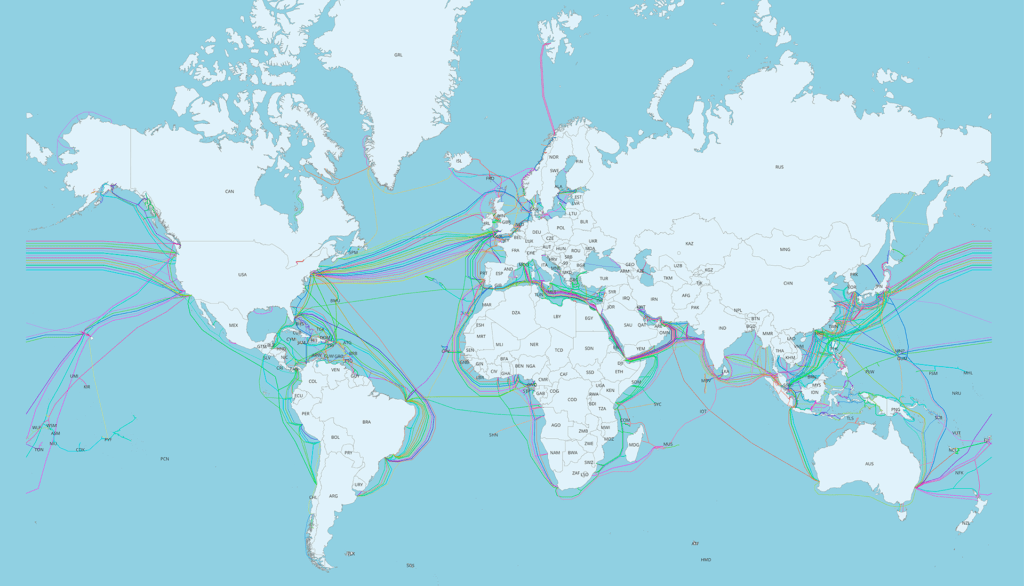
Picture: Submarine cables span the oceans, forming the physical layer that interconnects continents and supports global Internet traffic.
Different companies emerged, developing photonic devices for all-optical processing. Inside data centers, however, copper remained dominant due to its low cost, easy integration, and reliable short-distance performance (typically under 5–10 meters). To achieve higher reach, data centers utilized fiber but still relied on EPS combined with pluggable transceivers to interface with electrical systems.
In these longer links, each EPS port required electrical-to-optical (E-O) and optical-to-electrical (O-E) conversions. These conversions added latency, increased power use, and created demand for standardized optical transceivers. As a result, transceivers became essential for scaling bandwidth, giving rise to a multi-billion-dollar market with rapid innovation cycles.
This model worked for decades. But in late 2023, the rapid growth of Artificial Intelligence (AI) pushed EPS systems to their limits. Training large-scale models, such as Large Language Models (LLMs), requires massive data movement with tight latency constraints. Each network hop introduced buffering, queuing, and conversion delays, leading to variable latency and higher power consumption. As port speeds exceeded 100 Gbps and node counts increased, traditional electrical architectures faced severe bottlenecks, making further scaling difficult and costly.
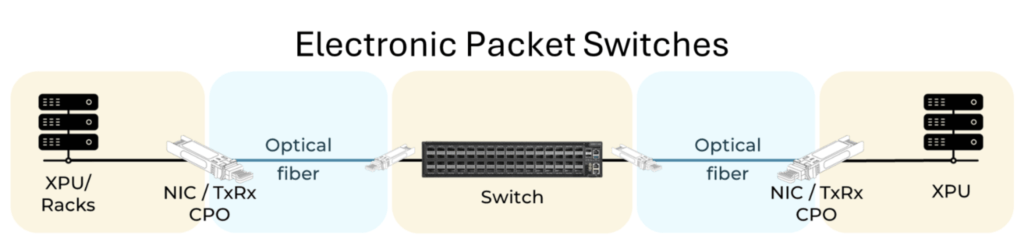
Picture: In the EPS architecture, data is switched electrically, requiring multiple E-O conversions.
Optical Circuit Switching for AI Workloads and Next-Generation Data Centers
As AI workloads exposed the performance and energy limits of packet-based switching, Optical Circuit Switches (OCSs) have reemerged as a viable alternative. OCSs bring back the principle of dedicated communication paths but now implemented with light instead of electricity and controlled via software, without manual intervention.
The first commercial OCSs appeared in the early 2000s, based on micro-electro-mechanical systems (MEMS). These systems use tiny movable mirrors to steer light between ports. MEMS-based OCSs are mature, reliable, and wavelength-agnostic. Their ability to support large port counts (high radix) has enabled adoption in high-performance environments. However, technology faces practical limits in switching speed, cost per port, and integration density.
To overcome these constraints, silicon photonics (SiPh) has emerged as the next stage of OCS development. SiPh enables with no moving parts, faster reconfiguration times, and higher on-chip integration. Its compatibility with standard CMOS processes allows manufacturers to scale production while reducing costs. Today, is still maturing, but its strong potential is already visible as it begins to make its way into early commercial deployments and next-generation AI data centers.
In real-world deployments, OCSs balance flexibility and stability. They can support dynamic traffic through software-defined orchestration. However, their benefits are most apparent in structured workloads, such as AI/ML clusters, where traffic patterns are predictable and repetitive. In these scenarios, circuits can be reconfigured in microseconds or even nanoseconds, enabling low-latency interconnects and contention-free communication across thousands of processors. This makes OCSs particularly effective in GPU clusters, where data must move in tightly synchronized, all-to-all patterns.
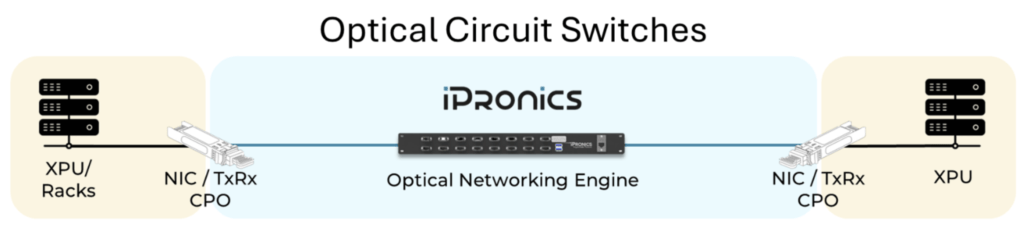
Picture: The OCS approach uses an end-to-end optical path, letting light travel directly between xPUs.
Will OCS Challenge EPS?
Not everywhere, but where it matters most, yes.
EPSs remain essential in general-purpose, dynamic environments. Their maturity, flexibility, and seamless integration with existing systems make them indispensable in many parts of today’s data centers. However, as AI and hyperscale networks grow in importance, OCSs offer a powerful alternative.
Recent innovations such as iPronics’ ONE-32 optical networking engine illustrate how SiPh-based OCSs are becoming tangible products. The iPronics ONE-32 is a 32×32 programmable optical circuit switch that combines solid-state reliability with microsecond-level reconfiguration times, high integration density, and software programmability. By leveraging CMOS-compatible fabrication, it reduces cost per port while offering the speed and scalability demanded by disaggregated optical infrastructure in the AI era.
In future data centers, flexibility will be key: OCSs will enable the structured, high-volume data movement that defines AI and advanced computing. Just as electrical packet switching powered the Internet era, optical circuit switching is prepared to shape the AI era.