

Can Silicon Photonics Optical Circuit Switching Keep Up with 1.6T Datacenter Optics?

AI datacenters are driving a rapid transition toward higher-capacity optical interconnects. As transceivers move to 1.6 Tb/s with 200G per optical lane, every element in the optical path needs to preserve increasingly demanding high-speed signals.
That raises an important question:
Can a programmable silicon-photonics Optical Circuit Switch be inserted into a 200G-per-lane link without significantly compromising signal integrity?
Together with Lumentum, iPronics tested exactly that.
Using 1.6 Tb/s 2×DR4 200G/lane retimed silicon-photonics transceivers and an iPronics Optical Circuit Switch, we evaluated end-to-end link performance under controlled network-loss conditions.
The result: near-transparent operation, with approximately a one-decade Bit Error Rate (BER) degradation from a 10⁻¹² baseline, while remaining robust to loss introduced before and after the optical switch.
Why this matters
An Optical Circuit Switch, or OCS, differs fundamentally from an electronic packet switch. Instead of converting the optical signal into the electrical domain, processing it, and transmitting it again, an OCS switches the optical signal directly.
That creates the potential for a programmable optical layer inside the datacenter. But it also means the signal must maintain sufficient quality as it travels through the photonic circuit. At 200G per lane, even relatively small impairments can matter.
A useful OCS therefore needs to do more than route light from one port to another. It needs to preserve the quality of the optical link.
Testing the link under controlled loss
To evaluate that, the experiment introduced controlled optical loss on both sides of the OCS. The test configuration included approximately 0-3 dB of loss before the OCS and 0-10 dB after it.
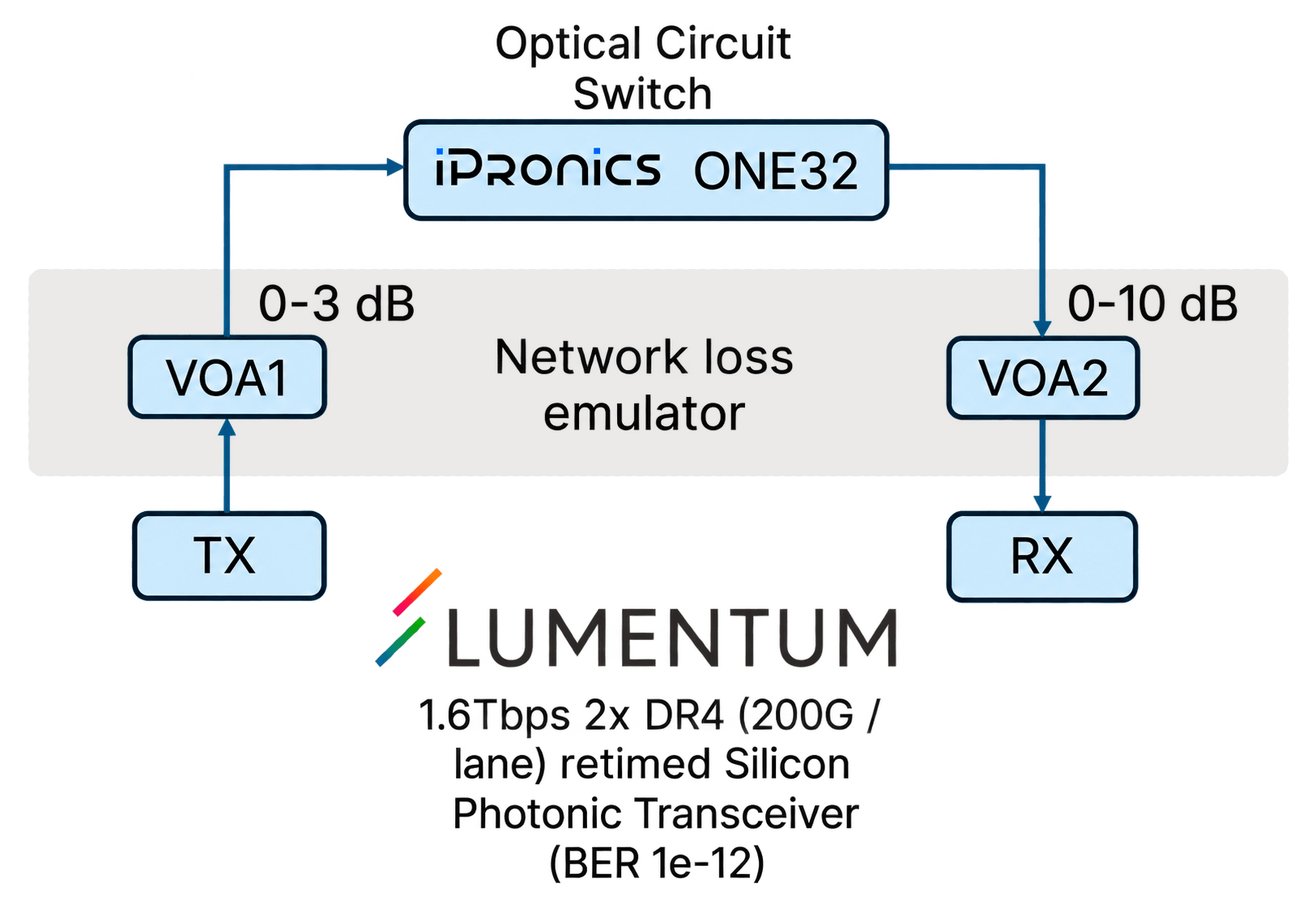
Testing loss on both sides helps reproduce different network conditions. Post-switch loss reduces the optical power reaching the receiver, while pre-switch loss changes the optical power entering the OCS itself. Together, they provide a more representative view of how the system behaves when optical conditions vary across the network.
The key result
The direct-link baseline reached BER performance around 10⁻¹². With the Optical Circuit Switch in the path, the demonstrated link showed approximately a one-order-of-magnitude BER degradation while remaining robust across the tested pre- and post-network loss conditions.
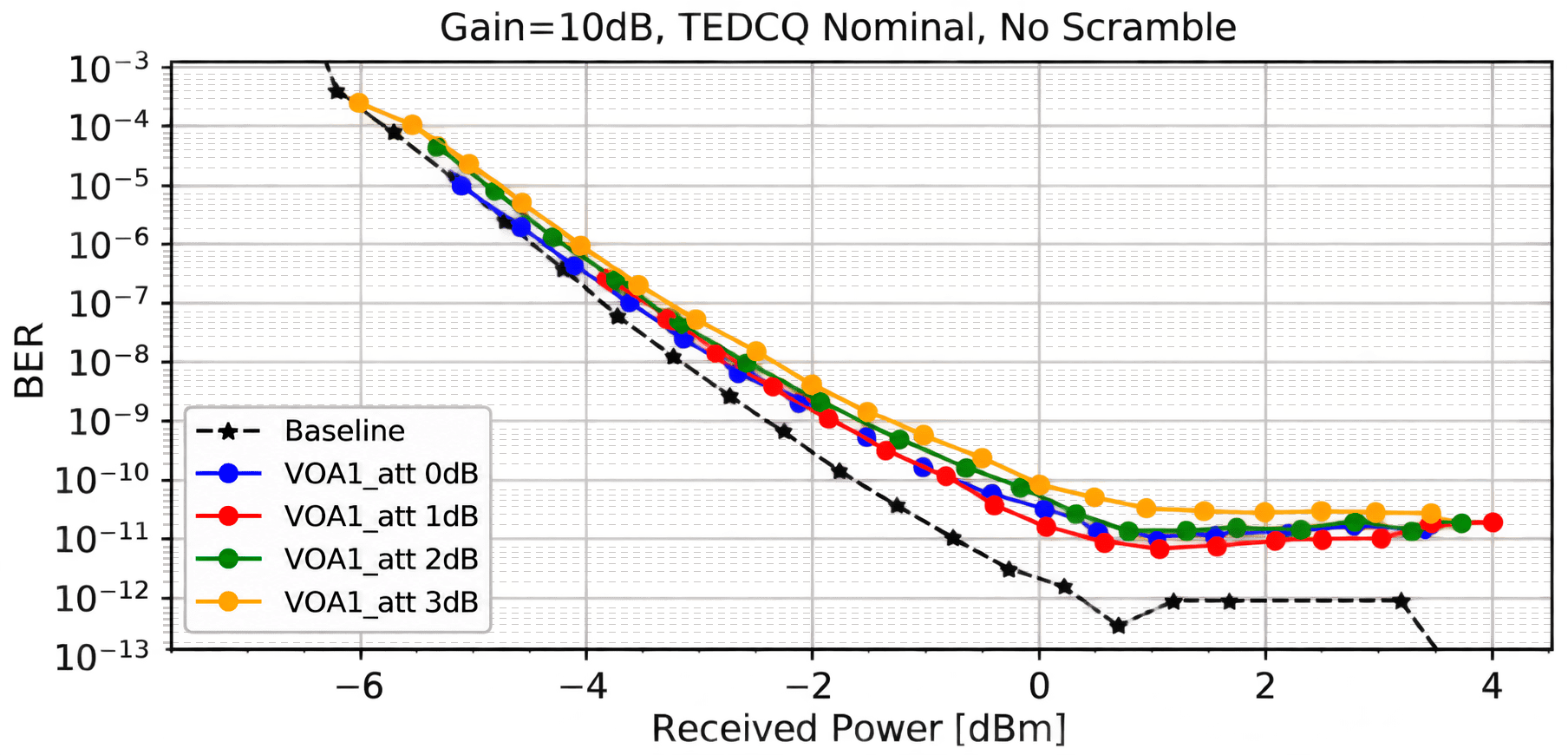
This goes beyond simply showing that light can be routed through the switch. It tests whether a high-speed 200G-per-lane signal can pass through a programmable optical switching layer while maintaining end-to-end link quality close to the direct-link baseline.
The results demonstrate robust performance under the tested conditions and show that the OCS can operate in the optical path without significantly compromising signal integrity.
Toward programmable optical interconnects
An OCS creates an optical path without needing to process the data carried by that path. That opens the possibility of making the physical optical topology inside the datacenter programmable.
As AI datacenters become increasingly dependent on optical interconnects, the ability to combine high-speed transceivers with programmable silicon-photonics switching becomes increasingly relevant.
The joint results with Lumentum show that 1.6T, 200G-per-lane optics can operate over the iPronics Optical Circuit Switch with near-transparent end-to-end performance under the demonstrated conditions.
For us, this is more than an interoperability demonstration. It is another proof point that programmable silicon photonics is ready to move deeper inside the datacenter.
A more detailed engineering report will follow soon, taking a deeper look at the OCS technology, experimental setup and test methodology, and BER performance under the different test conditions.